Latest Entries »

Shooting began today on the Thirty Decibels book trailer.

And what better way to kick off the production than to capture the story’s villain?

Meet CityLeader Frankel

CityLeader Hiram Frankel, AKA Jason Kingsley

CityLeader Hiram Frankel wields the most political power in East Jefferson, Texas, where main character Ava lives. In fact, Ava’s mother (a Whisperer) works for the man himself. His groundbreaking legislation will take away Whisperers’ only freedoms, and he hopes to extend these changes nationally. He represents the newest, most power-hungry generation of Leaders since the Whisper Rules went into effect nearly a century ago.

The shots

Sehban Zaidi, the director, shot several takes of actor Jason Kingsley giving a speech as CityLeader Frankel. Since we won’t be using his audio for the final cut, Jason made up his own powerful orations… about baked goods and tasty desserts. He had all of us giggling. Yes, every powerful villain has facets that make them human – I guess Frankel’s got a powerful sweet tooth.

Production Assistant Steve Kroodsma and Director Sehban Zaidi ensure they’ve got a great shot.


Before I get into the update – Chicago folks, we need your help!
We’d like to shoot early to mid-September and we need: 1) A choir rehearsal space, either in a school or church or theater, for a few hours; 2) A library for a few hours (bookstore may also work); 3) A high-school age choir group. These choir and library shots are very important to the trailer. So please get in touch if you know of any resources!

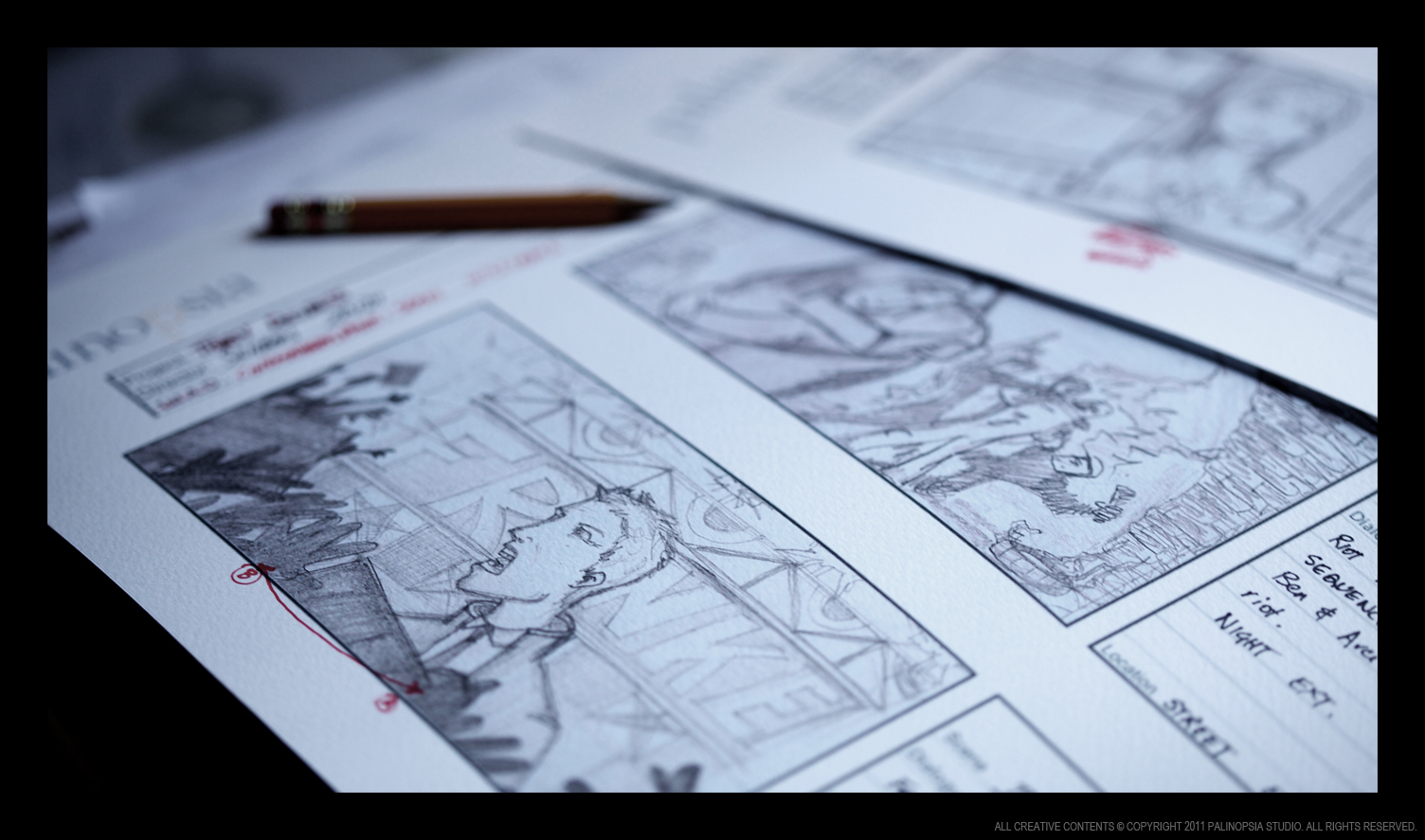
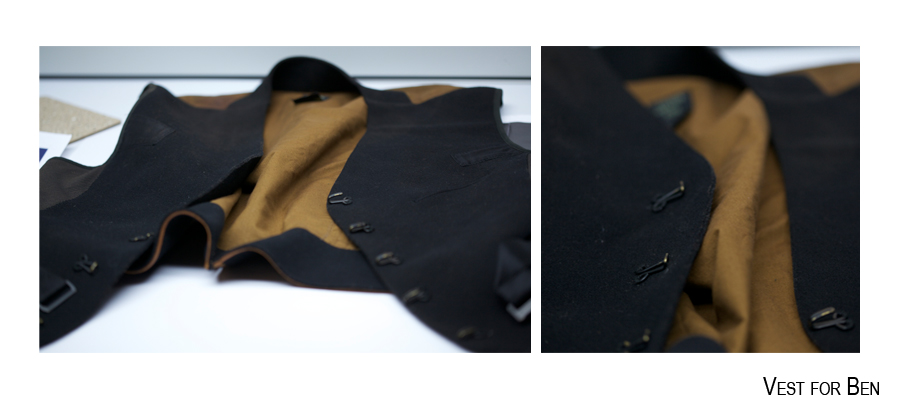
Lately, I’ve been working behind the scenes with Chicago’s Palinopsia Studio to prep for our Thirty Decibels book trailer shoot – finalizing storyboards, discussing wardrobe and props, and securing locations – all leading up to the upcoming shoot.

Thirty Decibels storyboard, showing main character Ava in the library: the only place Whisperers hold authority

Thirty Decibels storyboard, showing high-powered politico villain, CityLeader Frankel, using his full volume

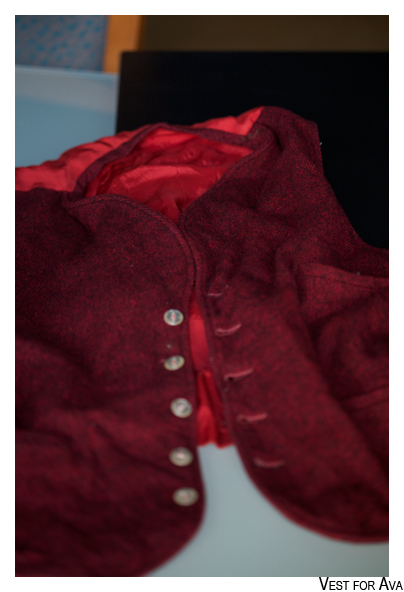
Wardrobe will take on a post-cultural layering theme.

Main character Ava's vest, to be paired with a white hoodie.

Short films are such a blast to work on. I have a little previous experience to draw from…

From 2000-2002, I worked for a large Chicago ad agency, Ogilvy & Mather. My main clients were Sears, Kenmore, Suave, and Dove – and I was lucky enough to art direct several TV spots. Basically, that means I helped create the “story” behind each commercial, helped cast the actors, and worked with the director, propmasters, effects artists, and editors to make sure that story idea came across effectively. After stepping foot on that first film set and seeing how efficiently film professionals could create a story from thin air, I was hooked.

In 2002-2003, I worked on the sets of a few short films: I was a set dresser for graduate student Rae Shaw’s film Soap and Roses, which earned the attention of film critic Jonathan Rosenbaum (here’s the unofficial review, and a sample scene); I was a PA (production assistant) / actor in a hilarious horror-comedy called Skunk Ape!? , which appeared in the Tromadance film festival (here’s my take); and a PA / actor in an adaptation of the rather talented Chicago author Joe Meno‘s I Was a Mathlete Until I Met Margo Marriswhich appeared in the Chicago International film festival, Tribeca film festival, and Dances with Films(Click the title to see the whole film. I’m not Margo Marris, but I have a fun cameo.)

I have such a soft spot for filmmaking – for the collaboration of skill, passion, wit, and elbow grease from everyone involved. And I’m so excited to be a part of that tradition again.

I look forward to posting our progress here as we go.
If there’s anything specific you’d like to see, or if you have any questions for myself or the director, fire them away below! We’d love to hear from you.

If I could describe SCBWI’s (Society of Children’s Book Writers and Illustrators’) annual international conference in one word, I’d call it:

infreakingtense.

But what can you expect from a group, 20,000+-strong, as they cap off their 40th year?

This was my first SCBWI-LA conference, and I only wish I’d stocked up on sleep beforehand. I was in for some serious inspiration.

This slideshow requires JavaScript.

Arriving late on the night before the festivities, I was wired enough that of course I didn’t get a proper night’s rest. Of course!

The first day began with a wonderfully honest and engaging run-down of writing advice from Bruce Coville. His first tip? Marry rich.

I took to heart another piece of Bruce’s advice: “Scare yourself.” Take on projects that rattle your nerves. You’ll grow immensely. He followed that up with “Stop scaring yourself” – meaning, don’t talk yourself out of taking action. I believe every writer struggles with this at one point or another. This sort of self-sabotage paralyzes everyone who’s ever wanted to write… but just hasn’t yet. A story’s in there. Just put it down. And “Don’t be afraid to show your heart,” as Bruce put it. “Don’t be sentimental, just honest.”

The conference was full of honest voices, including authors Laurie Halse Anderson, Judy Blume, Libba Bray, Donna Jo Napoli, David Small, Gary Paulsen, and Nova Ren Suma, agents Marcia Wernick, Barry Goldblatt, Tina Wexler, Michael Bourret, and Tracey Adams, publishers Julie Strauss-Gabel, Alessandra Balzer, Jennifer Hunt, Allyn Johnston, Debra Dorfman, and Beverly Horowitz, plus the SCBWI’s own exec director Lin Oliver and its president Stephen Mooser.

More than one of my favorite authors shared that they’d started writing to escape a sour marriage. Writing had given other authors refuge from personal demons. For one, writing became therapy in lieu of mental health coverage. Author David Small, whose vocal cords and ability to speak had been severed for 10 years following a neck surgery, rather appropriately quoted Vargas in his rousing talk: “Life is a shitstorm. And when it begins to rain, the only umbrella we have is art.”

If you want to write, trust me (and everyone who’s done it before): The story won’t be good right away. If you don’t believe me, take it from Judy Blume, whose book Summer Sisters didn’t truly emerge until her 23rd draft. Twenty-three drafts. So just put the words down, to start. Writing’s a little like recovering from alcoholism. Take it one step at a time, and through some steady work, you’ll get stronger. You’ll show your best self. (Yes, I take liberties with metaphor.)

Here’s my favorite part of attending SCBWI-LA: Wherever I looked, I knew I’d find someone just like me, toiling away on that thing they love. That story they have to tell. If they’d made the trip to SCBWI-LA like me, that means they’re just as serious about telling it. And I find so much hope in that. Don’t you?

Boy Toy: Playful title, haunting read

Cover of "Boy Toy"

Barry Lyga‘s Boy Toy opens with a list devised by main character Josh Mendel.

Ten Things I Learned at the Age of Twelve:

1. The Black Plague was transmitted by fleas that were carried throughout Europe by rats.

2. If you first paralyze it, you can cut open a frog and watch its lungs continue to inflate and deflate.

3. There are seven forms of the verb to be: am, being, been, is, was, were, and are.

4. In order to divide fractions, you invert the divisor to arrive at the reciprocal, which is then multiplied by the dividend. (Mixed fractions must first be converted to improper fractions.)

5. In Salem, the witches weren’t burned at the stake – they were pressed to death under big rocks… or hanged.

6. Islam was founded in the year 610. It is the third of three world religions worshiping the same god.

7. Each point on a “coordinate plane” (created by the joining of an x-axis and a y-axis) can be described by an ordered pair of numbers.

8. “Monotheism” is a belief system centered on a single deity, while “polytheism” subscribes to belief in multiple deities.

9. The area of a circle can be determined by using the formula πr2, where r is the radius of the circle.

10. How to please a woman.

At first glance, the list seems almost tongue-in-cheek. But as soon as you know you’re about to launch into the story of one boy’s sexual abuse by his seventh-grade history teacher, your brow furrows. Your heart begins to sink.

For the most part, the story’s told through Josh’s eyes, five years after the incident in question. You start to piece it together from Josh’s harrowing “flickers,” little memories from months of abuse that tend to interrupt any given moment without warning. A clearer picture emerges from a number of sustained flashbacks, and the years since have given Josh a chance to reflect. But two inciting incidents drive the relationship back into his consciousness, almost to a breaking point: 1. Josh’s abuser is freed from prison early, and 2. After years of avoiding the classmate who brought his situation to light, he runs into her and must face his own wrongdoing.

Like any seventeen-year-old’s life, Boy Toy does have its light moments. These become essential in heavier stories like this, both to keep readers going with something to smile about, and to ensure the action and tension remain true to life.

For Josh, seventh grade and its aftermath turned into a battleground of control and manipulation – without his even realizing it. Afterwards, despite frequent visits with a psychologist, he continues his fight against others’ views of control. But alongside several surprising reactions to everyday events (some culminating in a sudden violent side), Josh begins to make painful decisions of his own. It’s not that Josh’s abuse forced him to grow up. It forced him to see how un-grown-up he’d really been, through it all.

This book will mean something unique and unforgettable to everyone who reads it.

Find Boy Toy on Indiebound and Amazon.